
|
Getting your Trinity Audio player ready...
|
It’s not always easy being a rising star. People want a piece of you, judge you based on your latest post on social media or if you’re not present there, they’ll judge you further. Who you talk to, what you wear, where you choose to relax on holiday, what you eat and drink. Being a rising star in the microcosm of the Côte de Nuits, probably the wine worlds’ biggest pedestal, can be even more intimidating.
Charles Lachaux, 6th generation owner of Domaine Arnoux-Lachaux in Vosne-Romanée, seems very easy with the whirlwind of the last few years. The curly haired, shy-looking Charles seems unphased by what is going on in Burgundy in general but more importantly, the funfair and celebration in which every new release of his wines is met.
Talking to him about his Viticulture (he sees himself fiercely as a vine grower first, after which all other tasks come, including winemaking) and the changes he has introduced, it is hard to believe he is in his early 30s . some of the methods are so clear to him, he doesn’t feel the need to experiment on a small scale first. It’s as if he received a vision or a message that it will simply work. You don’t get much of an answer when asking for his source of inspiration. But I suppose, will an artist be able to always explain their choice of a certain brush, linen, or thinning method for their oils?
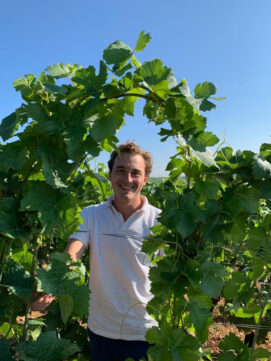 Allowing vines to grow ‘wild’ to three or four metres in height, in Burgundy, is something not many growers will entertain. The standard height of vines in Burgundy is around one metre of the ground. Lalou Bize Leroy famously tends to her vines the natural and tall way, by binding the shoots and never taking to summer trimming. When she started doing so, more than twenty years ago, explaining that she didn’t wish to hurt her vines and that they should be able to express themselves, the wine world gave her the credit she deserves with that embracing nod all romantic poets and philosophers often get. Mentioning Bize-Leroy and suggesting she may be the source of his method provokes the only minor sign of agitation during our conversation. Lachaux is obviously an enormous fan of Bize-Leroy’s wines and status. However, the constant comparison between them by outsiders is obviously wearing thin. Lachaux is quick to point out that he never worked for Domaine Leroy and yes, he is admirer of her Viticulture philosophy, but he passionately states that this is where any similarity ends and from there on every aspect of their work is totally different.
Lachaux’s method of letting his vines grow and arching them is backed by a complete science. Distance between buds, foliage ratio, crop, depth of roots, maturity of grapes (some of his Vosne Romanee vines are picked a month before his neighbours!), shading and aeration. A strong building block on which the rest of the Arnoux-Lachaux revolution of operation is founded.
He seems almost satisfied telling me that vines, growing naturally and climbing wild will not produce many grapes at all. Nature did not intend for vines to produce wine. His crop ranges from 13-25 Hl/Ha. This tightrope between growing a healthy, natural vine and producing a world-class wine (as well as looking the accountant in the eye) is an act the young Charles Lachaux has no problem navigating.
Then comes the cellar work. Complete cluster fermentation is the method in which Charles puts his trust. Entirely. Exceptions are rare. Hail damage is the most common reason for deviation from that rule. Again, no longer a revolutionary method, many growers already use it in Burgundy but not many will stick by it for their entire production, in any vintage. Lachaux clearly wants to deliver a simple message from his vines to the consumer, in the most natural, least interfering way.
Fermentation is a flash “blink-and-you-missed-it” affair. 6 days in average with some tanks completing their fermentation in less.
Yeasts, if you are still wondering by now, are all home grown. Lachaux is obviously proud, not just at the impressive vigour of his Saccharomyces but also their diversity within his plots.
To my suggestion he should cultivate and market them to his friends, he smiles shyly and offers the recommendation that each should stick to what nature has given them. This, I increasingly believe, is his raison d’etre.
Foot-treading, punching-down and some pump-overs complement the carefully thought-out extraction regime. Some days he will choose one or more of those methods and the next day he might not touch the tank. A result of his internal dialogue with the lively fermenting vats.
Opening his range is his Pinot Fin, made from vineyard within Chambolle-Musigny, Nuits-St-Georges and Vosne-Romanée. The ‘Fin’ clone of Pinot Noir is one normally found only in Premier and Grand Cru vineyards. Famous for producing Millerandage grapes (or tiny ‘shot’ grapes) full of concentration and high pulp-skin ratio. This ‘Bourgogne Rouge’, made from very old vines, is a treat and a shop window, in the words of Lachaux that acknowledges that most consumers will find his village and above wines too expensive for their budget.
The three villages of Chambolle-Musigny, Vosne-Romanée and Nuits-St-Georges form the trio of village wines on offer, with multiple plots in each.
The Premier Cru wines are also a combination of small plots in Vosne-Romanée, (with their own pedigree but famous neighbours such as La Tache) and Nuits-St-Georges.
The four Grand Crus are all more or less 0.5-hectare plots in Romanée St-Vivant, Échezeaux Les Rouges, an excellent plot in Clos De Vougeot and a single outpost in Gevrey-Chambertin, with a Latricieres Chambrtin which the family acquired in 2008.
With growing admiration from far and wide (including a congratulating comment on his Instagram account by the French President!), Lachaux is feeling lucky he is able to practice his gentle, attentive practices on such a hallowed Pinot Noir Terroir.
The most sought after, cerebral grape doesn’t need over complications.
Keep it natural and simple is his overwhelming message.
If you ever get the chance, walk the tall vineyards of Lachaux, listen carefully and if you’re sensitive enough and lucky, 140,000 vines might whisper their happiness in your ear.
